Only warm white LEDs ok? Unless you’re building hospitals, over 3500K is unnecessary violence
— Shiloe Bear (@shiloebear) March 28, 2023
ARTIFICIAL BRIGHTNESS
https://nature.com/articles/s44284-025-00239-5
https://theconversation.com/health-and-safety-problems-from-white-led-streetlights
https://theconversation.com/street-lamps-arent-the-only-form-of-artificial-light-pollution
How to create darker nights
by Georgia MacMillan, Marie Mahon, Thérèse Conway / July 28, 2025
“Without a view of the stars at night, Don McLean would never have been able to write Vincent and Vincent van Gogh would not have painted Starry Night. Viewing a sky full of stars is part of what makes us human. The light from stars has travelled thousands of miles to reach our eyes. But now, most Europeans live under unnaturally bright night skies. That ancient starlight is now diluted by human-made light pollution. So where is all this extra light coming from? A recent German study reveals that, contrary to common assumption, public street lighting may not be the biggest cause of light pollution. The sources are closer to home. Improved energy efficiencies in LED technology means that artificial light is now cheaper than ever to run. As a result, people are lighting up front doors, sheds and garden paths like never before.
???In 2007 Congress passed a law that banned all bulbs under 45 lumens/watt (an incandescent bulb is 15 lumens/watt). The Department of Energy in 2022 made the final rule to go into effect in 2023 (which it did). In 2024 a new rule passed which will go into effect in 2028… pic.twitter.com/I9DUYY4hT4
— Roger Seheult, MD (@RogerSeheult) July 19, 2025
Artificial light at night has undoubtedly revolutionised our productivity and transformed our social environment as the sun sets. However, when used excessively or inappropriately, artificial light at night becomes light pollution. This changes our outdoor spaces by creating daytime conditions at night. In particular, LEDs emitting high levels of harsh blue-white light are known to scatter more widely into the atmosphere, increasing levels of light pollution, which can have unintended consequences by interrupting our sleep cycles and circadian rhythms and disrupting nature at night. Just one lamp can attract hundreds of insects, many of them important nocturnal pollinators, away from their natural environment, every single night. Once trapped in what’s called the “vacuum cleaner effect” of artificial light, scientists estimate that over 30% of these insects will die before dawn from exhaustion or predation. This disrupts the balance of nocturnal ecosystems.
The German researchers used a specially developed mobile app called NightLights to survey sources of light at night. More than 250 citizen scientists surveyed their local surroundings. The results challenged common assumptions that streetlights are the primary contributor to urban light pollution, and showed that residential, commercial and other non-street lighting sources play a significant role in brightening our night skies. In Ireland, we are coordinating similar surveys as part of a pilot programme to raise awareness of light pollution. Some of the most noticeable sources of night light include home security lights being angled up instead of down, garden runway lights over-illuminating pathways throughout the night and considerable light spilling from large windows without blinds or curtains.
Another growing issue in Ireland is the increasing intensity of illuminated sports grounds, often reported to the environmental non-profit group Dark Sky Ireland by concerned residents. These issues can be easily resolved. Light pollution is just about the simplest of all pollutants to fix. Our study focuses on County Mayo’s Dark Sky Park, a place where naturally dark skies are protected and internationally recognised as a cherished form of natural heritage. We examined the role of dark sky tourism and community engagement in addressing light pollution. By making some simple changes to the type of light and being a little more judicious about how it is used, the level of unnecessary light currently polluting our night skies can be reduced.
The community of Newport, County Mayo, has led the way in making these changes with some impressive results. Light pollution over the town of Newport has been reduced by 50% by redesigning the town’s lighting scheme – this award-winning project focused on replacing excessive flood lighting on heritage and architectural structures with a sensitively designed lighting scheme to enhance the town’s nightscape. As a feature of this initiative, the beautiful stained glass window at St Patrick’s Church in Newport, created by 20th-century artist Harry Clarke is delicately interpreted with light at night. Lighting solutions that help protect dark skies include angling outdoor lights downwards and using shielded lamps to avoid illuminating the sky. Only direct light towards the area that needs to be lit, not into a neighbour’s garden or home. Use a visually warmer colour of light (such as amber) to reduce glare and improve conditions for wildlife and natural sleep cycles. Employing timers ensures that lights are only switched on when needed. By making small changes to how we light our homes and gardens at night, the beauty of a starry night can be restored for generations to come.”
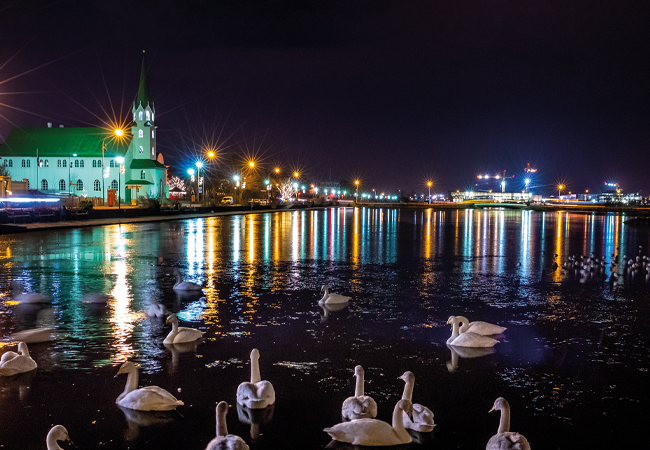
“Four-fifths of the world lives under light polluted skies that
can affect all species ofanimals, birds, insects and plants”
BLUE LIGHT DISTRICTS
https://lichter.nachtlicht-buehne.de/about
https://forbes.com/street-lamps-arent-the-main-source-of-light-pollution-in-cities
https://cibsejournal.com/night-time-blues-impact-of-white-leds-on-light-pollution
The night-time blues: the impact of white LEDs on light pollution
by Iain Macrae FSLL MCIBSE / December 2022
“For nearly 100 years we have installed exterior lighting to provide illumination on roads and in outdoor spaces, so that people can enjoy the night-time, travel from here to there, and feel safer. Over that time, we have had many discussions on the latest and best solutions. Initially, light was for safety as we drove new-fangled cars at speed along roads trying to avoid pedestrians and cyclists. Along the way, we have researched and invested in better technologies and methods of lighting. From mercury lamps to LEDs, there has always been a reason to upgrade – the latest and greatest story being the energy we save.
The real question might be, why, at the same time, did we not see the mess we were creating in the way of light pollution? Sure, we have benefited people and it is safer to travel. There is better night-time entertainment, though research suggests we might be healthier adjusting our sleep patterns to the natural length of the day as the seasons change (Thomas Kantermann, 2007; Wright, 2009; Kohsaka, 1992). The impression is of greater community safety, though, in my area, it is rare that people use the all-night street lighting to take a walk, and the only house to be burgled in recent years sits right next to a streetlight. This feeling of safety, by the way, has a diminishing return above five lux (Svechkina, Trop and Portnov, 2020).
- Four-fifths of the world lives under light-polluted skies: the Milky Way is hidden from more than one-third of humanity, while 88% of Europe and 50% of the USA experience perpetual twilight. (Falchi, 2016)
- Global light pollution is up by 45% in 25 years, according to satellite imagery, but the real increase may be more like 270% – and even 400% in some regions. (Sánchez de Miguel, Bennie, Rosenfeld, Dzurjak and Gaston, 2021)
- Human circadian sleep/wake cycles, and those of many other species, are affected by light from the blue end of the spectrum. (Sanders, 2021)
- Blue light has a significant impact on photosynthesis. (Aubé, 2013)
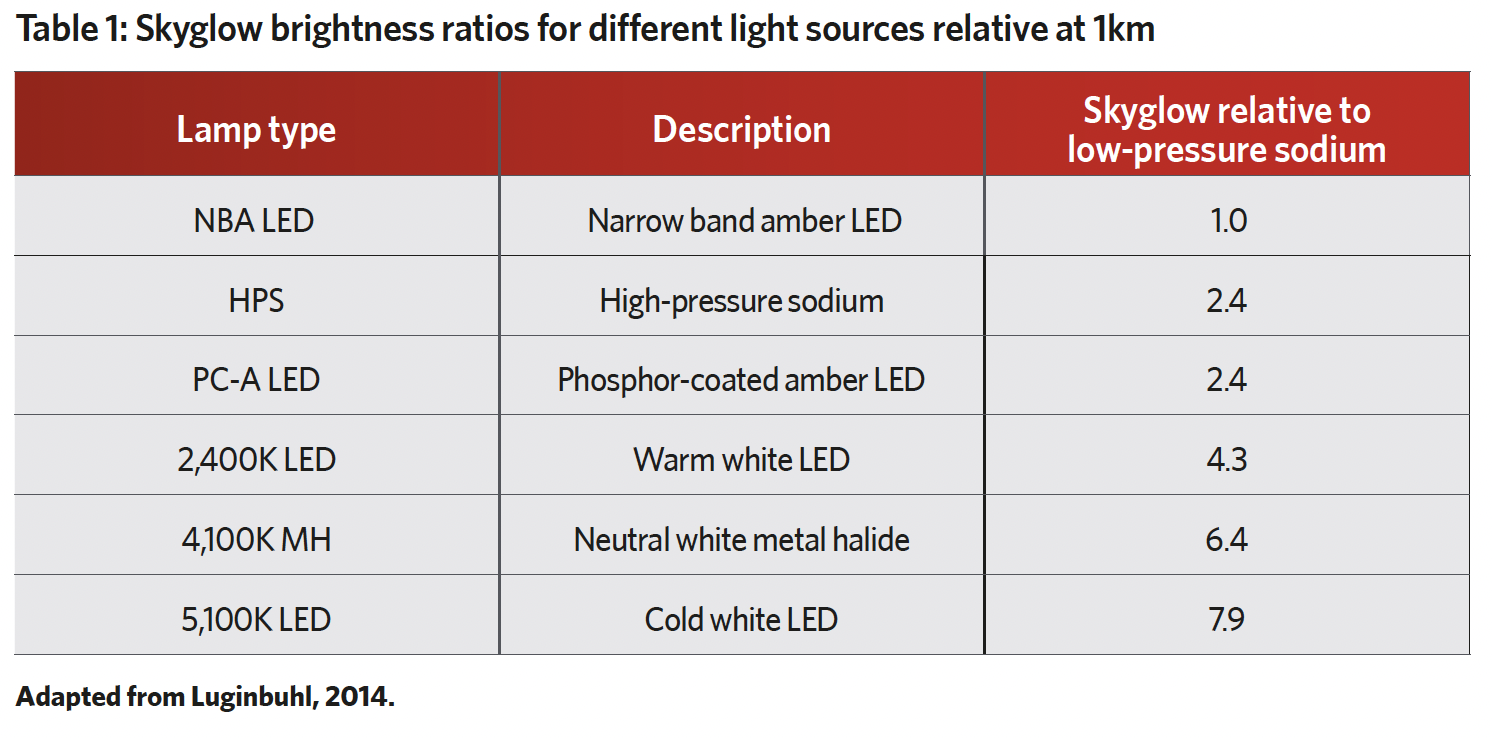
- Blue light is a major contributor to skyglow. (Luginbuhl, 2014)
The outcomes of night-time lighting have not been truly understood until recently. The body of evidence has been growing for more than a decade and, along with it, the number of concerned and protesting voices. We have underestimated the amount of light pollution and remained blind to how bad it really is. The facts opposite estimate an increase in light pollution between 270% and 400%, yet the measurement is only 45%. The blue in our story is largely about our failure to measure light pollution effectively – sensors within the measurement satellites we have been using do not measure blue light.
This has increased because many white LED street lights have a spectrum that contains a strong spike in the blue wavelength. That not only increases localised skyglow, but also has a particular and direct impact on life for the planet’s inhabitants, whether human, animal, insect or plant. What about white light generally? Two things have led to an increase in white light used outdoors, gradually replacing the widespread use of sodium sources. Research confirms that, by using white light, we can reduce the amount of light we need for the same visibility (Knight, 2010). This, and the technological revolution that is LEDs, has led to rapid adoption for savings in energy.
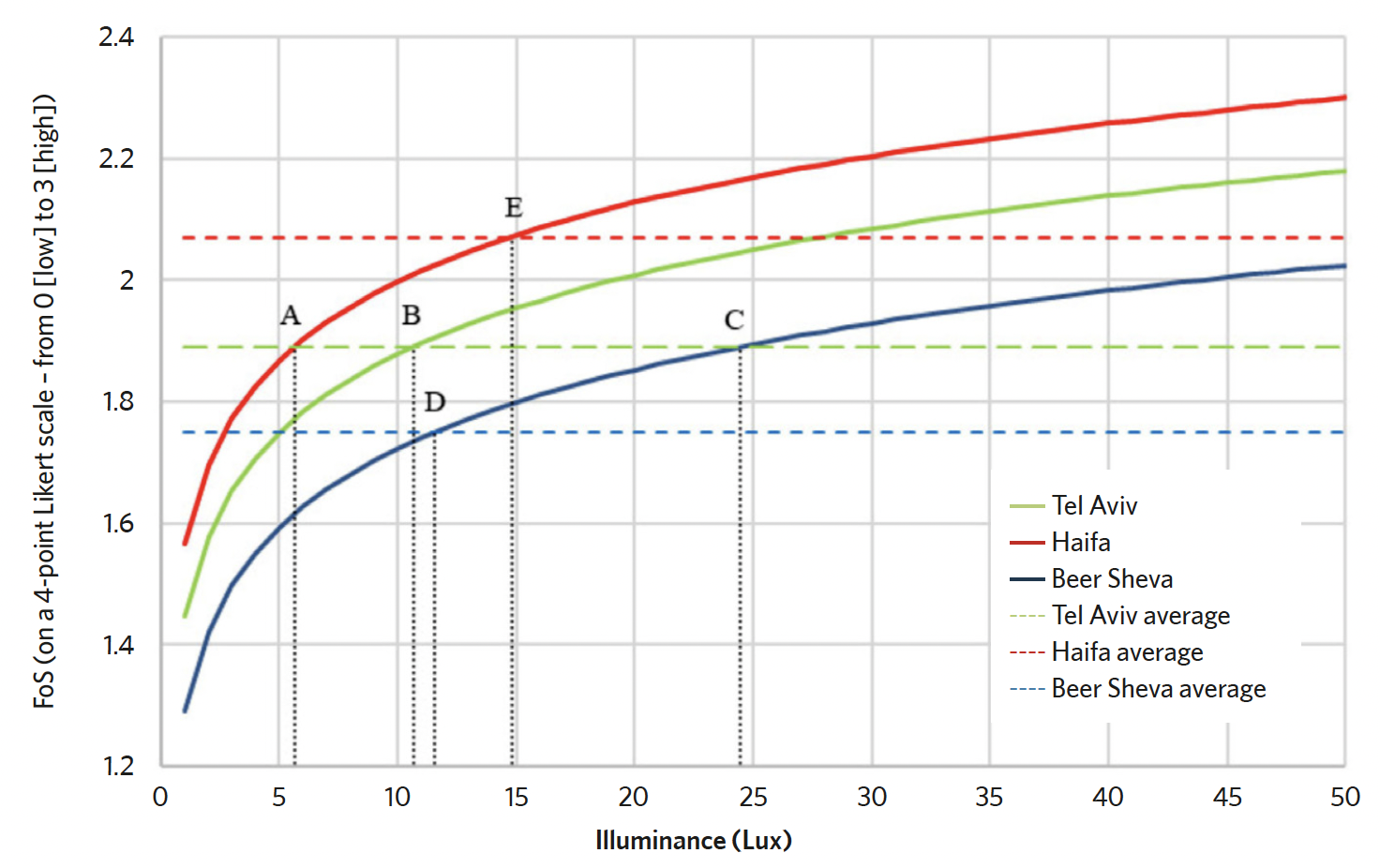
Figure 1: How much light is required to feel safe (Svechkina et al, 2020)
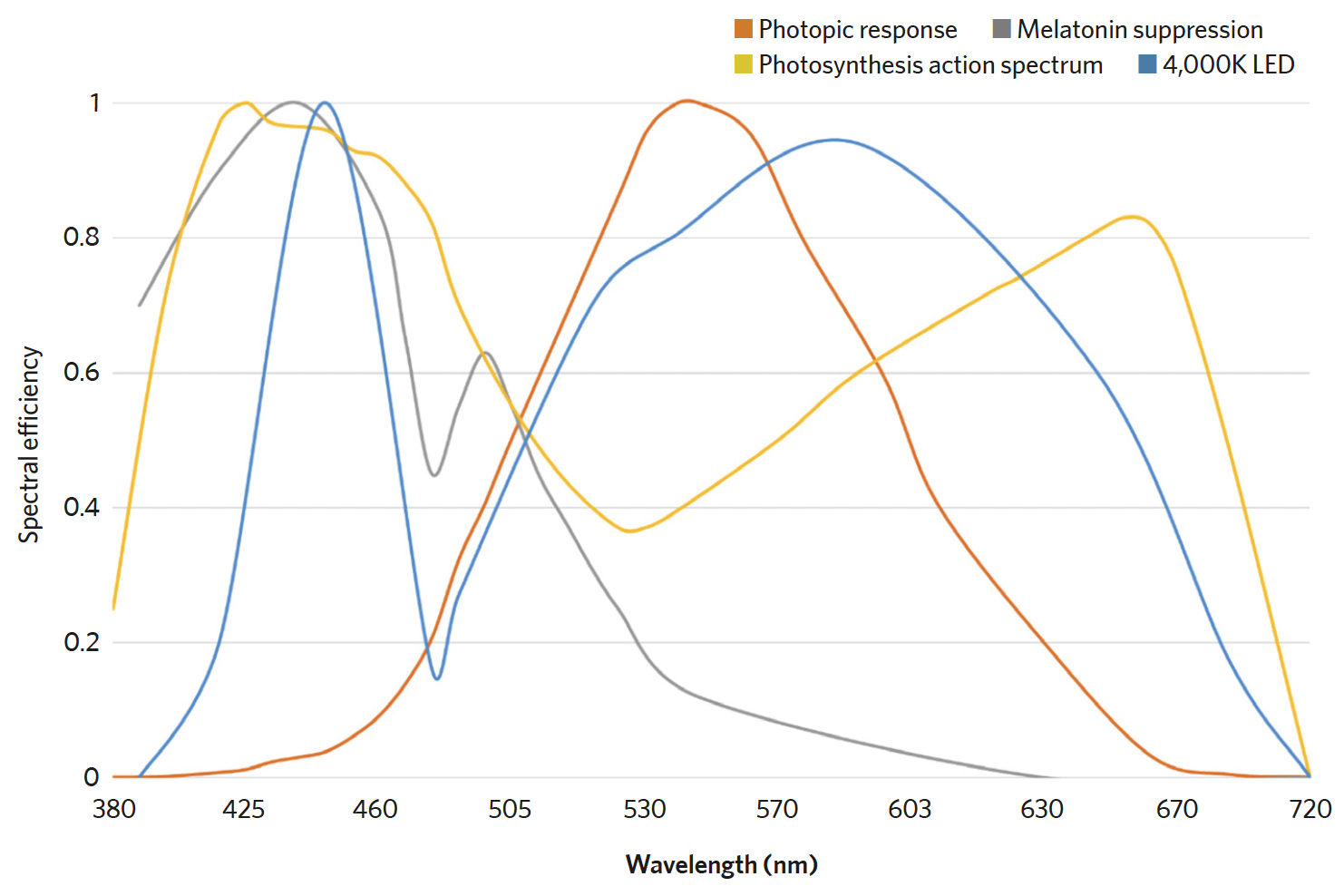
Growing evidence, however, shows that the number of lighting points is increasing as the cost to purchase and use LED lighting has fallen. The Jevons Paradox – an increase in efficiency in resource use will generate an increase in resource consumption rather than a decrease – strikes again. As mentioned above, the wider use of white light and LEDs increases the amount of blue light in the environment. The technology of LEDs often uses blue-light-generating diodes, coated with phosphor to create the white light we see. In the process, these white light sources emit a lot of the blue end of the spectrum. In cold colour appearance LEDs, 4,000K-6,500K, this blue content is considerably higher. Hence, our move to use white light, first with metal halide lamps and then LEDs, has increased skyglow. The Jevons Paradox has made this worse as we add more light to our public spaces and to our gardens as the falling cost makes it viable.
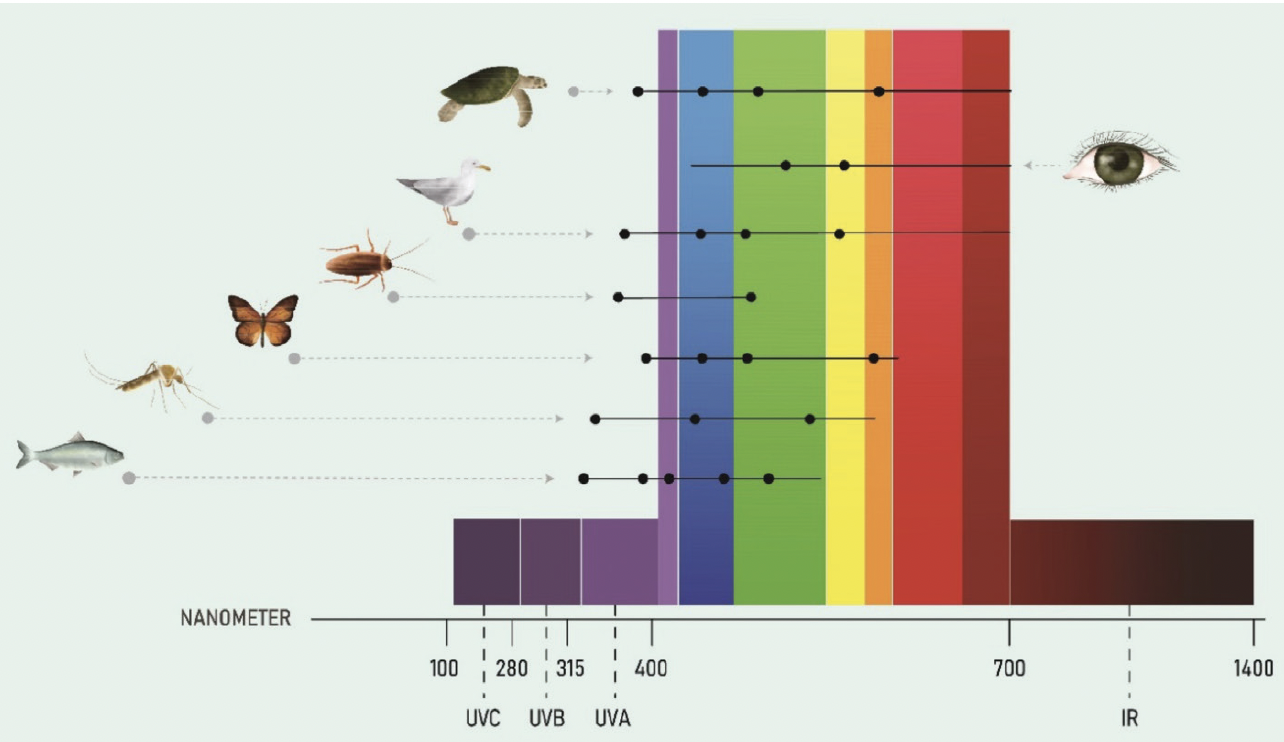
Figure 2: Ability to perceive different wavelengths of light in humans and wildlife is shown by horizontal lines. Black dots represent reported peak sensitivities. Figure from National light pollution guidelines for wildlife, including marine turtles, seabirds and migratory shorebirds, Commonwealth of Australia 2020
Use of white light has also impacted insect populations. While you might like the fact there are fewer flies around to annoy you, the long-term ill effects on nocturnal species and plant pollination are already starting to show (Avalon C. S. Owens, 2020). That leaves us with a problem: how to reduce light pollution and, specifically, skyglow? The amount of skyglow increases near densely populated areas (Bierman, 2012) and our current light pollution guidance (ILP, 2020) allows for a further increase with every new installation.
Guidance allows light onto façades in all but protected areas, and this light then reflects into the sky. Limits on upward light into the sky in rural, suburban and urban areas range from 2.5% to 15% for luminaires, meaning that new installations are allowed to add upward light, making the current situation even worse. If light pollution guidance sets targets that allow a site to increase upward light, then skyglow can only increase as our cities grow. Could it be time to ban upward light and limit façade lighting to buildings of historical importance? Light pollution guidance offers some solutions, including recommending fixtures that only emit light below the horizontal, and consideration of task focus and the amount of light. Even so, light often reflects off the façade, road, decking or paving, and this reflected light is still a concern.
‘Many white LED street lights have a spectrum that contains a strong spike in the blue wavelength, which is most effective at suppressing melatonin during the night. In the absence of electric lighting, humans begin the transition to night-time physiology at about dusk… These 4,000K lighting fixtures may contribute to delay in the transition, which could, at a minimum, reduce sleep quality.’
‘Of particular importance is the now voluminous data showing a higher risk of hormonally linked cancers with melatonin suppression, such as breast carcinoma (an increase risk of about 15%) and prostate carcinoma.’

‘The visual discomfort that can be created by very intense point sources, especially for older drivers, is magnified by higher colour-temperature LEDs because blue light scatters more in the human eye, leading to increased disability glare.’
‘Many beneficial insects are drawn to blue-rich lighting, and circle under them until they become exhausted and die… Even bridge lighting that is “too blue” has been shown to inhibit upstream migration of certain fish species, such as salmon returning to spawn.’
– Extracts from LED street lighting: the human and environmental effects by Dr Mario Motta, Light Lines May/June 2022, special ROLAN issue
In the table, you might notice two LED solutions that offer an alternative way forward – which brings us to the red in this article. Reducing the blue content of our light sources will definitively reduce skyglow. Using narrow band or phosphor-coated amber LEDs, while reducing colour rendering, will also impact skyglow. Red LEDs would go a step further. These light sources are not white light. For sure, your expensive electric vehicle paint work is going to look a little off colour parked on the street at night, but there is good evidence that using such technologies will significantly reduce the impact of human lighting on our ecosystem. Maybe it’s time to rethink our negative connotations of a red-light district and use this light for all our benefit.
More information
The May 2022 ROLAN (responsible outdoor lighting at night) Conference, co-organised by the SLL and Dr Karolina M Zielinska-Dabkowska, head of Illume, brought together world experts on artificial lighting at night. For selected articles by key speakers visit here.”
PREVIOUSLY
DARK SKIES
https://spectrevision.net/2022/01/24/dark-skies/
NON SPECTRAL COLORS
https://spectrevision.net/2022/11/14/nonspectral-colors/
FLUORESCENT MAMMALS
https://spectrevision.net/2023/10/10/fluorescent-mammals/
