
“3D coronal magnetic field above an active region on June 1, 2022” Credit: NSF/NSO/AURA
CORONAL MAGNETIC FIELDS
https://phys.org/news/2024-10-era-solar-international-team-global.html
https://phys.org/news/2026-06-superstorm-drew-current-ions-earth.html
Sun’s outer magnetic field mapped in 3D for the first time
by Audrey Merket, NSF National Center for Atmospheric Research / October 28, 2026
“A team of researchers has produced the first global, three-dimensional estimates of the sun’s magnetic field, including the area beyond the sun’s visible edge. This marks a step toward more accurate models of solar activity—and ultimately, better predictions of solar magnetic eruptions, which are the root cause of extreme space weather that can impact critical infrastructure technologies on Earth. Scientists have been able to observe the structure of the sun’s upper atmosphere—called the corona—for decades but haven’t been able to measure the full magnetic field responsible for shaping it. Now, a new study demonstrates a way to fill that gap by applying a new method to existing observations from the Mauna Loa Solar Observatory (MLSO), which is operated by the U.S. National Science Foundation National Center for Atmospheric Research (NSF NCAR).
The method of reconstructing the sun’s elusive 3D coronal magnetic field by extracting previously inaccessible information from these observations is published today in The Astrophysical Journal Letters. “By applying a novel method to observations from the Mauna Loa Solar Observatory, we produced the first determinations of the coronal magnetic field’s strength and 3D direction across the regions where MLSO observations are available,” said Daniela Lacatus, an NSF NCAR researcher and one of the paper’s co-authors. “These results help to overcome a major bottleneck in measuring the coronal magnetic field that has persisted for decades.”
The study was conducted by researchers from NSF NCAR, the U.S. National Science Foundation National Solar Observatory (NSF NSO), and Southwest Research Institute. To create the 3D maps of the coronal magnetic field, the research team built on two previous research endeavors: a study that produced the first 2D global maps of the coronal magnetic field, using data from an instrument called the Upgraded Coronal Multi-channel Polarimeter (UCoMP) located at MLSO, and a novel technique known as the IQUD inversion. The IQUD inversion has shown promise in both theoretical and statistical tests. Combining the two methods, the research team focused on using data from the original Coronal Multi-channel Polarimeter (CoMP) on Oct. 14, 2016, and UCoMP on June 1, 2022.
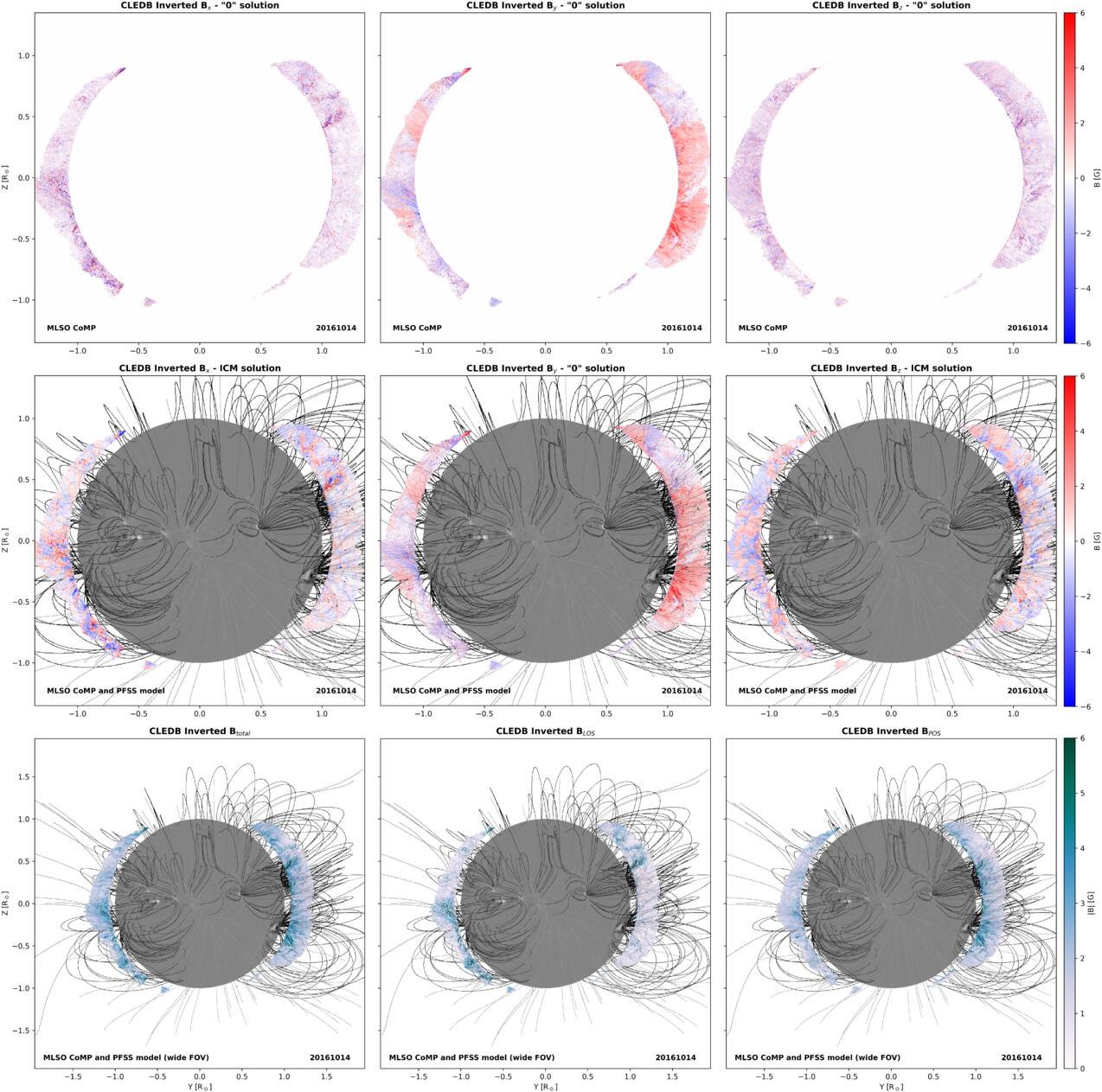
“CoMP inversions of the vector coronal magnetic field on 2016 October 14.”
The result was the ability to pull out information encoded in waves traveling through the corona to reconstruct the 3D coronal magnetic field. “For the first time, we can begin to see the sun’s hidden magnetic architecture in three dimensions not by building a new type of ground or space instrument, but by decoding the light and waves already coming from the sun’s corona,” said Alin Paraschiv, an NSF NSO researcher and the study’s lead author. “For a star whose magnetic activity influences everything from the solar wind to the auroras dancing across Earth’s skies, being able to measure more of that hidden architecture could transform our understanding of how the sun works.”
While the study represents the transition from a theoretically demonstrated technique to an observationally demonstrated capability, the initial magnetic-field maps have limitations. Additional development and validation will be necessary before the approach can become a routine capability. To encourage that progress, the team has made its analysis software and data sets openly available, allowing other scientists to test, refine, and extend the method. “It’s very exciting to see MLSO data used as a pathfinder to advance our ability to predict solar eruptions,” said Tom Berger, MLSO director. “The team has done an amazing job at demonstrating how our advanced COSMO coronagraph network—the follow-on to the current MLSO facility—will enable new observations of the sun’s magnetic field, filling a critical gap in our observations of space weather drivers.”
MLSO data from CoMP and UCoMP are publicly available. Researchers should be able, in theory, to generate 3D coronal maps applying the IQUD inversion from any day that suitable observations are available from either instrument. The method developed by Paraschiv and his colleagues is openly available, but has not yet been integrated as a data product into operational observatory pipelines. They hope that it will one day be a standard data product in the advanced COSMO observatory network. “When we did the validations, we were so excited to see that the results look reasonable and comparable to what we’d expect,” said Lacatus. “People have already told us how excited they are about this and we really want them to come test the method to help us see where it can be tweaked and refined. We’ve proved the method can work and now we just need to make it broadly available to the community.”
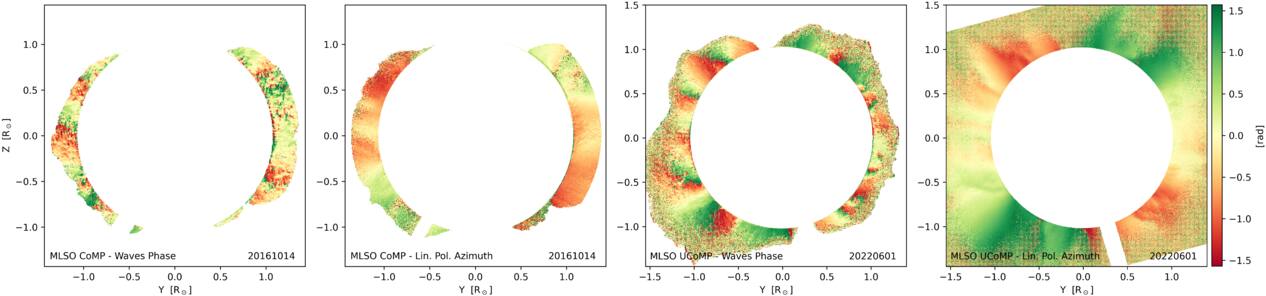
“The azimuthal orientation of the field is presented through two inferences.”
Publication details
Alin Razvan Paraschiv et al., A First Global Full-vector Coronal Magnetic Field Inference Using MLSO CoMP and UCoMP Observations, The Astrophysical Journal Letters (2026). DOI: 10.3847/2041-8213/aead9e
PLASMASPHERIC HISS
https://phys.org/news/2026-06-superstorm-drew-current-ions-earth.html
https://phys.org/news/2026-10-solar-storm-triggered-ultrarelativistic-electrons.html
2024 solar storm triggered ultrarelativistic electrons inside Earth’s ‘impenetrable barrier’
by Nagoya University / October 28, 2026
“The Earth is surrounded by an invisible barrier that was thought to prevent highly energetic electrons from reaching closer to our planet. But in 2024, Japan’s Arase space probe detected these electrons well inside the barrier. Now, research led by Nagoya University has found evidence that the electrons were accelerated locally rather than infiltrating from outer radiation belts. The Earth’s magnetic field traps energetic charged particles, namely protons and electrons, in two donut-shaped belts called the Van Allen radiation belts. These particles can potentially damage hardware and electronics in spacecraft flying through the belts.
At the inner edge of the second Van Allen belt, at roughly 3 Earth radii from Earth’s center, electrons with extremely high energies seem to hit an invisible, impenetrable wall. This barrier was first discovered in 2014, and its source is not completely understood. One possibility is a phenomenon known as “plasmaspheric hiss“: low-frequency radio waves in the Earth’s magnetosphere that produce static noise when played through a speaker. Human-made very-low-frequency radio transmissions, used to communicate with undersea submarines, may also help shape this boundary by scattering radiation-belt electrons into Earth’s atmosphere.
Under typical conditions, this region of space is devoid of extremely fast-moving electrons. But space weather can be as precarious as what we experience on the planet. In May 2024, high solar activity unleashed a geomagnetic ‘superstorm’ on Earth. The aurora borealis, or northern lights, appeared in night skies in Hokkaido and in places as far south as Hyogo prefecture. During and after this superstorm, the Japanese radiation space probe Arase, operated by JAXA, collected data from within the impenetrable barrier. And sure enough, it recorded a large flux of high-energy electrons moving close to the speed of light.
Some electrons had energies exceeding three megaelectronvolts—high enough to go through some satellite shields. The so-called impenetrable barrier seemed to have been broken. The researchers looked for possible explanations. “One of the key questions was how these highly energetic electrons appeared inside the barrier,” said Yoshizumi Miyoshi, a professor at the Institute for Space-Earth Environmental Research (ISEE) at Nagoya University and the lead author of this study. “Were they transported inward from the outer radiation belt, or were they accelerated locally within this region?”

“Detailed schematic outlining the process of electron acceleration inside the
impenetrable barrier.” Credit: Miyoshi et al., Geophysical Research Letters, 2026.
The first clue came from analyzing electron phase space density (PSD), a quantity that describes how electrons are distributed according to their energies and motion. Using measurements collected during multiple Arase orbits, the researchers examined how PSD varied with distance from Earth while accounting for changes in the electrons’ motion. They found that a distinct local peak in PSD developed near the usual barrier boundary and became stronger over time. Such a growing peak provides evidence that electrons were gaining energy locally, rather than merely being transported inward from the outer radiation belt.

“Ultrarelativistic electrons in impenetrable barrier following solar superstorm.”
Credit: Miyoshi et al., Geophysical Research Letters 2026
But what gave them this boost? Arase also detected intense electromagnetic waves that repeatedly swept upward in frequency. “When converted into audio, it sounds like a bird song,” Miyoshi said. These chirping waves, called “chorus waves,” are natural, low-frequency electromagnetic waves that ripple through the Earth’s magnetic field. These waves can transfer energy to electrons when their oscillations match the electrons’ spiraling motion around magnetic field lines. Their effect was particularly pronounced in May 2024 because the storm had dramatically eroded Earth’s plasmasphere, a region filled with relatively cool charged particles. Its outer boundary retreated unusually close to Earth, leaving the region around the previously impenetrable barrier much less densely populated with plasma. This allowed hotter electrons to reach farther inward and generate chorus waves.
Additionally, the depleted plasma density did not recover quickly. “Typically, the plasmasphere recovers on a timescale of about two days,” Miyoshi said. “During the May 2024 superstorm, however, it took approximately 4.3 to 4.7 days for the plasma density to recover to more than half of its pre-storm level in the observed region.” This unusually slow recovery allowed the low-density plasma conditions to persist for several days, potentially providing favorable conditions for chorus-wave activity and the continued acceleration of energetic electrons inside the previously impenetrable barrier.
Miyoshi said these findings, published in the journal Geophysical Research Letters, demonstrate that even regions of near-Earth space previously considered relatively protected from extremely energetic electrons can experience substantial radiation enhancements during severe space weather events. “This discovery highlights the need to understand and predict how energetic electrons behave under extreme space weather conditions,” Miyoshi said. “Such knowledge is important for assessing radiation risks to spacecraft and improving future space weather predictions.” The findings also provide new insights into how the Earth’s magnetosphere responds to extreme solar activity, emphasizing the importance of continuous observations of the near-Earth space environment.”

“VLF spectrogram of electromagnetic hiss“
Publication details
Y. Miyoshi et al., Local Acceleration of Multi‐MeV Electrons Inside Earth’s Impenetrable Barrier During the May 2024 Superstorm, Geophysical Research Letters (2026). DOI: 10.1029/2026gl125879
PREVIOUSLY

SPACE WEATHER and REVOLUTIONS
https://spectrevision.net/2018/12/10/space-weather-and-revolutions/
IONOSPHERE MAPPING
https://spectrevision.net/2024/12/19/ionosphere-mapping/
PLASMA BUBBLES
https://spectrevision.net/2024/09/10/plasma-bubbles/
