
“Typical lunar seismograms for different event types. The plotted events are those that were used as prototypes in the event classifier. (a) Shallow moonquake. (b) Deep moonquake (belonging to cluster A20). (c) Impact.”
MOONQUAKES (cont.)
https://wikipedia.org/Apollo_12_Passive_Seismic_Experiment
https://link.springer.com/article/10.1007/s11214-020-00709-3
https://agupubs.onlinelibrary.wiley.com/doi/10.1029/JB087iS01p0A117
https://phys.org/news/2006-04-rumblings-moon-problematic-lunar-base.html
Rumblings on the moon could be problematic for lunar base / April 7, 2006
“As NASA envisions it, astronauts will return to the moon within the next decade or so. Unlike in the earlier, quick, Apollo visits, these astronauts will build a permanent base and prepare for an historic undertaking that will send explorers to Mars. As Clive Neal, associate professor of civil engineering and geological sciences at the University of Notre Dame, envisions it, these same astronauts may be in for a shocking — and rocking — surprise. Neal and a team of 15 other planetary geologists have reexamined data from seismometers placed by Apollo astronauts at lunar landing sites from 1969 to 1972. They found that instruments from Apollo missions 12, 14, 15 and 16 consistently radioed back seismic data to Earth until they were turned off in 1977 in a NASA cost-cutting measure. Neal and his colleagues discovered a surprising number of relatively large “moonquakes,” including some that lasted a remarkably long time. “The moon is seismically active,” Neal said. “When a quake occurs, the moon rings like a bell.”
There are four different types of moonquakes. Deep moonquakes, occurring at roughly 700 kilometers below the surface, were most likely caused by lunar forces triggered by the effect of Earth’s gravity. Other quakes were caused by vibrations from the impact of meteorites, and “thermal quakes” were caused when the frigid crust of the moon expanded when struck by the morning sun after two weeks of deep-freeze lunar night. The first three classes of moonquakes were generally mild. However, shallow quakes, which occurred only 20 or 30 kilometers below the surface, were another story. They were powerful and long-lasting. “Between 1972 and 1977, the Apollo seismic data detected 28 shallow quakes,” Neal said. “A few of the shallow quakes registered up to 5.5 on the Richter scale. A magnitude 5 quake on Earth can move heavy furniture and crack plaster.”

“Spectrograms of the SPZ component of (a) the prototype impact shown in Figure 1c, (b) the prototype shallow moonquake shown in Figure 1a, (c) an event newly detected and classified as impact on 1972/227, and (d) a close impact on 1974/153 listed in the LPEC and wrongly classified as shallow moonquake by the original classifier. The waveform of the event in Figure 7d was subsequently used as prototype for the new event class “near impact.”
Neal points out that vibrations from most earthquakes cease in less than a minute. The biggest earthquakes stop shaking in less than two minutes. The shallow quakes on the moon produced movement that continued for more than 10 minutes. Neal and other scientists aren’t exactly sure what causes the shallow moonquakes, although they suspect that the rims of large and relatively young moon craters may slump and cause them. They also aren’t sure precisely where the quakes are occurring. “The Apollo seismometers were all in one relatively small region on the front side of the moon, so we can’t pinpoint the exact location of these shallow quakes,” Neal said.
Although he isn’t sure of the precise location of the shallow quakes, Neal is convinced that NASA needs additional analysis and data before proceeding with construction of a permanent lunar base. In the corner of his office is a floor-to-ceiling bookshelf containing binders of data from the Apollo missions, which he continues to analyze and which, he feels, will offer important guidance for the planned return to the moon. He notes that we know relatively little about the lunar poles, which is critical given that one suggested location for a lunar base is a region on the rim of Shackleton Crater at the south pole of the moon that is permanently sunlit. NASA planners also will need to develop building materials that are flexible enough to withstand the stress of shaking and bending from these long-lived shallow moonquakes. Neal also believes that the moon can offer critical data that will potentially impact the planned missions to Mars. “The moon is a technology test bed for establishing such networks on Mars and beyond,” he said.
WET MOON
https://phys.org/news/2017-07-scientists-spy-evidence-moon-interior.html
https://phys.org/news/2016-05-water-logged-history-moon.html
https://phys.org/news/2014-03-moon.html
A wet Moon
by Astrobio.net / March 26, 2014
“The Moon’s status as a “dry” rock in space has long been questioned. Competing theories abound as to the source of the H20 in the lunar soil, including delivery of water to the Moon by comets. This week, Tartèse et al announced in Geology that new analyses of lunar soil samples demonstrates that basalts from the Moon’s mantle contain hydrogen from water indigenous to Earth. According to the authors, their work is “challenging the paradigm of a “dry” Moon, and arguing that some portions of the lunar interior are as wet as some regions of the Earth’s mantle.”
The Moon’s origin is believed to be the Earth itself, which gave rise to the Moon when a Mars-sized object impacted our planet around 4.5 billion years ago. The Earth’s mantle is known to be partially water. These latest finding raise the odds that the Moon may have a partly-aqueous core today. These results promise that at some time in the past there was water in the Moon’s mantle, inherited from an ancestral proto-Earth, which rose to the surface in magma, and became trapped in crystals called apatites. How much water remains, and how it can be accessed to support human habitation, will be a subject of ongoing study.”
Romain Tartèse, Mahesh Anand, Francis M. McCubbin, Stephen M. Elardo, Charles K. Shearer, and Ian A. Franchi. “Apatites in lunar KREEP basalts: The missing link to understanding the H isotope systematics of the Moon.” Geology, G35288.1, first published on February 25, 2014, DOI: 10.1130/G35288.1
TIDAL HEATING
https://phys.org/news/2011-01-lunar-core-deep-interior-moon.html
https://phys.org/news/2026-11-earth-gravity-early-moon-volcanic.html
Earth’s gravity may have kept the early moon’s volcanic heart beating
by Andy Tomaswick, Universe Today / November 7, 2026
“We typically think of the moon as a static, floating object that has remained the same for basically its entire lifetime, with an occasional asteroid impact serving as an exception. That understanding is grounded in physics—the moon should have cooled rapidly after forming when a huge protoplanet hit the early Earth around 4.5 billion years ago. But some lunar material returned from the Chang’e-5 mission was notably formed only around 2 billion years ago, yet appeared to be volcanic in origin. So how did a world that was supposed to have settled down without volcanism remain hot enough to create these materials more than 2 billion years after its violent birth? A new paper from Miao Chen of the Chengdu University of Technology and his colleagues, recently published in the journal Planet, offers an explanation — tidal heating.

“Image of the volcanic lunar mare from LRO”
Let’s first set the stage of the moon’s creation. Our best guess is that it was created when another early protoplanet, named Theia, slammed into Earth in a massive collision, creating a chunk of debris that coalesced into the moon. However, that amount of debris was relatively small—only about a quarter the size of the Earth itself, which meant the internal heat generated during its formation would rapidly radiate away, turning the moon itself geologically dormant.

“Distribution of magnetic anomalies at the lunar surface.”
Credit: Science Advances (2025). DOI: 10.1126/sciadv.adp3333
But when Chang’e-5 returned some lunar basalts from Oceanus Procellarum back to Earth, laboratory dating showed them to be only around 2 billion years old. Basalts are only formed in active volcanoes or other environments with similarly high pressures and temperatures—environments that, at least according to traditional geological theory, shouldn’t have existed on the moon 2 billion years ago.
Despite that, scientists have tried offering other solutions. Radioactive elements, such as potassium and uranium, emit some heat as they decay. But there wasn’t enough undecayed material left on the moon to offer the amount of heat needed to form basalt 2 billion years ago. Asteroid strikes could cause localized high-impact thermal spikes, but the heavy bombardment period that gave the moon most of its craters had ended long before the basalt was formed. So instead the authors turned to gravity—specifically to a phenomenon called tidal heating. This happens when a celestial body is squeezed, stretched and kneaded as it travels in an elliptical orbit around a larger parent body.
Perhaps the most famous example of this in the solar system is Io. This moon of Jupiter is constantly erupting due to the tidal squishing it undergoes during its orbit around the largest planet. Obviously, the moon doesn’t seem to be undergoing any such squishing currently. However, 2 billion years ago, the moon was much closer to the Earth than it is today, orbiting our planet in 16 days rather than the 27 it takes now. Its orbit was also much more eccentric, looking much more like an oval than a circle. All of this means that Earth itself exerted huge rhythmic tidal forces on the moon’s interior during the course of its orbit.

“An artist’s rendering of the lunar core as identified in new findings by a NASA-led research team. According to their paper, the moon possesses a solid, iron-rich inner core with a radius of nearly 150 miles and a fluid outer core with a radius of roughly 205 miles. It also has a partially molten boundary layer around the core, estimated to have a radius of nearly 300 miles.”
We’ve known that for a while, but astronomers have always modeled the moon as a mostly uniform sphere when trying to understand how these gravitational squeezes affected it. However, scientists knew this was a simplification—there is an ultra-low-viscosity zone of rock wrapping itself between the moon’s core and mantle. When the research team plugged a more realistic 3D representation of the mantle setup into a convection simulation, they noticed that a ton of energy was directed specifically at two symmetric regions along the lunar core-mantle boundary.
These regions, which they named tidal heating anomaly zones (THAZs), absorbed a huge amount of energy. They calculated that, around 3.2 billion years ago, despite taking up only 2.5% of the mantle’s total volume, the tidal strain on these regions delivered 150 gigawatts of power—more than four times the amount of energy generated by radioactive decay. This seemed to be the driving force behind much of the moon’s geological history.

“Chang’e-6 landing site locates to the southern Apollo basin in the northeast
of the South Pole-Aitken basin, lunar farside.” Credit: Y. Qian
It helped keep the lunar core warm, which helped sustain a magnetic field for much longer than the models originally predicted (and was a puzzle when scientists realized that Apollo lunar samples seemed to have formed in a strong magnetic field). It also drove huge mantle plumes that swelled toward the crust. Billions of years later, long after the tidal engine had calmed down, those stranded pockets of mantle melted to produce the basalts seen in the Chang’e-5 samples.

“Intrusive magmatism is extensive across the South Pole-Aitken basin,
whose products highly likely collected by the Chang’e-6 mission.” Credit: Y. Qian
If there’s one thing that’s clear from the paper’s theory, it’s that we still don’t know a lot about the moon’s geological history. This new model offers some elegant answers to some of the most persistent questions in that area, but as of now it’s still only a theory. Maybe some of the numerous lunar missions planned over the next decade will be able to provide more definitive data to finally solve the evolutionary questions of our nearest neighbor.”
Miao CHEN et al., Tidal Heating Anomaly Zone at the core-mantle boundary of the Moon, Planet (2026). DOI: 10.15302/planet.2026.26014
“proposed tidal heating anomaly near the lunar core–mantle boundary”
MOLTEN MOON
https://astronomy.com/why-does-same-side-of-moon-always-face-earth
https://phys.org/news/2026-11-earth-primordial-crust.html
Earth’s slowing spin may have shaped its primordial crust
by Sam Jarman / November 5, 2026
“Around 4.5 billion years ago, a planet-sized object collided with the newly formed Earth, throwing out the debris that would later form the moon. The collision left Earth spinning extremely fast, with days lasting just two to five hours. Yet existing models of how Earth’s first crust formed and evolved have largely overlooked how the planet’s later slowdown might have affected it. Through new analysis, Simon Lock at the University of Bristol has revealed that as Earth’s spin slowed and the planet grew rounder, its changing shape was likely an as yet neglected driver of early tectonic activity. His findings are published in the Journal of Geophysical Research: Solid Earth.

“The shape of Earth with different angular momentum representing different stages of lunar recession, demonstrating that the early Earth was substantially oblate and its shape changed considerably during lunar tidal evolution.”
Immediately after the impact that formed the moon, Earth’s rapid rotation flattened it into a squashed sphere, bulging outward at the equator. In the most extreme scenarios, its width at the equator may have been up to twice its height from pole to pole. Over time, however, tidal interactions between Earth and the moon pushed the moon into a wider orbit, gradually slowing Earth’s spin and allowing the planet to become rounder. Almost none of the crust from this ancient period survives today, having been destroyed by billions of years of geological activity and erosion—making physical models crucial for understanding what happened. Yet the few fragments that do remain reveal a surprising diversity of rock types early in Earth’s history: usually explained by processes such as asteroid impacts or activity in the mantle recycling the original crust.
To address the limitations of previous models, Lock combined calculations of Earth’s shape and internal structure with models of how the moon’s orbit changed over time. This allowed him to compare conventional moon-formation scenarios with alternatives that leave Earth spinning far faster, and then to calculate the possible geological consequences as its surface was stretched and compressed. His results suggest that in the flattened early Earth, the outward pull of its spin partly counteracted gravity near the equator, likely allowing a thicker crust to form there than at the poles.

“A conceptual illustration of Earth’s evolution during the early period of lunar tidal recession. The depth of the crust and ocean are exaggerated, but the oblateness of Earth is to scale for the aftermath of a high-angular momentum Moon-forming impact.”
As the planet then grew rounder, the crust stretched near the poles and was squeezed around the equator, producing movements that could have rivaled those of modern plate boundaries for up to tens of millions of years. In some fast-spin scenarios, the squeezing briefly reached rates comparable to the collision that formed the Himalayas, extending all the way around the equator. If these calculated deformations are accurate, they would have had far-reaching consequences. As surface rocks altered by water and weathering were buried and remelted, they could have helped produce silica-rich rocks resembling those found on today’s continents.
Meanwhile, rising pressures inside the planet could have made parts of the lower crust dense enough to sink into the mantle, creating chemically distinct regions deep within Earth. Together, these processes could better explain how Earth’s rocks became so diverse so soon after its formation. Lock’s work highlights rotation as a key yet overlooked ingredient in Earth’s earliest geology. He now hopes that by including it in future models, researchers could gain a much clearer picture of how our planet’s surface first took shape, along with the seeds of its first continents.”
S. J. Lock, Tectonics on Early Earth Driven by Earth’s Changing Shape During Tidal Recession of the Moon, Journal of Geophysical Research: Solid Earth (2026). DOI: 10.1029/2025jb033676

“A few hundred million years after its formation, the Moon was subject to intense volcanic activity. The distance between the Earth and the Moon was much smaller back then than it is today.” Credit: MPS/Alexey Chizhik
TIDALLY DRIVEN REMELTING
https://phys.org/news/2022-10-change-samples-reveal-young-volcanism
https://phys.org/news/2024-12-moon-young-crust-violent-volcanism.html
Violent volcanism may mean moon is much older than previously thought
by Birgit Krummheuer, Max Planck Society / December 18, 2024
“After its formation, the moon may have been the scene of such immense volcanic activity that its entire crust melted several times and was completely churned through. At that time, the moon orbited significantly closer to Earth than today. The resulting tidal forces heated up its interior and thus powered the violent volcanism. Only Jupiter’s moon Io, by far the most volcanically active body in the solar system, offers comparable conditions. These new considerations published today in the journal Nature by an international team of researchers from the University of California Santa Cruz, the Max Planck Institute for solar system Research (MPS) and the Collège de France resolve previous contradictions and inconsistencies regarding the age of the moon. According to the researchers, the moon was formed between 4.43 and 4.51 billion years ago. Its crust, however, appears around 80 to 160 million years younger. The moon is apparently quite reluctant to reveal its age.
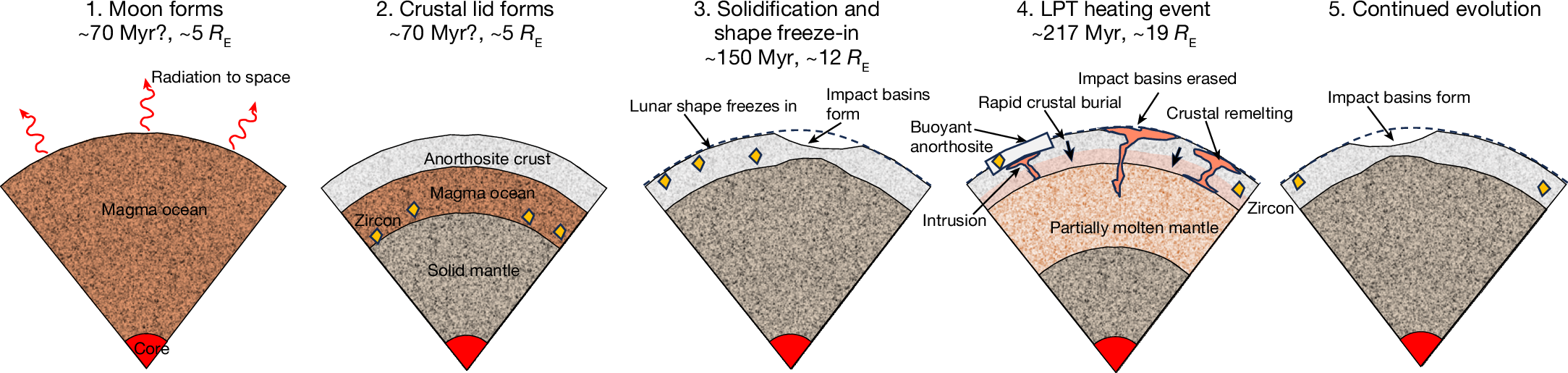
“The Moon probably formed at around 5 RE (ref. 53) and its shape froze-in at about 12 RE (see text) and was not modified by the later tidal heating event (the LPT) at about 19 RE. However, the intense volcanism and reheating and/or burial associated with this event reset all crustal chronometers except for relict zircons, and erased pre-existing impact basins. Here time in million years (Myr) is counted forwards from the formation of the Solar System at 4,568 Myr before present.”
Attempts to uncover its secret have yielded estimates that lie several hundred million years apart: While some researchers suggest that our cosmic companion was formed 4.35 billion years ago, others date its birth to 4.51 billion years ago. One of the most striking inconsistencies is of a stony nature: Almost all lunar rock samples point to the younger age. But a few rare crystals of zirconium silicate, known as zircons, are significantly older. How is this possible? In the current study, the researchers succeed in resolving this contradiction. According to their calculations, the moon’s crust was mostly melted again after its formation; only a few zircons were able to withstand these extreme conditions unchanged.
The history of the moon begins with a massive collision. In the early days of the solar system, a chunk about the size of Mars crashed into the still young Earth. The collision generated so much heat that our planet melted completely and hurled a huge amount of material into space. By and by, this material clumped together to form the moon, initially covered by a huge ocean of hot, liquid rock. In the millions of years that followed, the newly formed body cooled and moved further and further away from the Earth until it reached its current orbit at a distance of around 384,400 kilometers. “We are particularly interested in the phase when the distance between the Earth and the moon was about one third of today’s distance,” explains Francis Nimmo from the University of California Santa Cruz, first author of the new study.
At this time, there were various changes in the position and shape of the moon’s orbit. Among other things, it became more elliptical, so that the speed of the moon and its distance from the Earth varied noticeably within each orbit. The forces acting in this way “churned” through the moon’s interior to such an extent that it heated up. A similar situation is still known today from Jupiter’s moon Io, which travels around the gas giant also in a slightly elliptical orbit. The enormous tidal forces of Jupiter make the small moon the most volcanically active body in the solar system. Earth’s early moon was likely a match even to Io.
As the researchers’ calculations show, the heat flow from the lunar interior was sufficient to melt and churn through the entire mantle. While at no time during this phase a magma ocean covered the entire moon, over the course of several million years the heat from the interior gradually reached every part of the surface, liquifying most of the crustal rock—possibly even several times. In some places the hot lava penetrated to the surface, in others magma was injected beneath the surface, heating the rocks around it.
This volcanic history is decisive for determining the age of the crustal rock. Since their formation, lunar rocks (like terrestrial rocks) contain radioactive isotopes. Isotopes are variations of certain atoms that differ only in the number of neutrons in the atomic nucleus. As the isotopes’ decay times are known, it is possible to deduce the age of the rock from their current concentration. The decisive factor: As long as the rock is hot, it can exchange isotopes with its surroundings. When it cools, it locks in its composition. The trapped radioactive isotopes begin to decay—and the geological clock starts ticking. “The strong volcanism likely reset the moon’s geological clock,” explains Thorsten Kleine, Director at the MPS and co-author of the study. “Lunar rocks samples therefore don’t reveal their original age, but only when they were last strongly heated,” he adds.
Only a few heat-resistant zircons provide evidence of the more distant past, the researchers show in their calculations. In some places where the lava did not reach the surface, the zircon grains remained cool so that their internal clock was not affected. “The lunar rock samples tell us the moon’s entire, turbulent history. They tell us about its formation and its later violent volcanism. Until now, we just didn’t read these clues correctly,” says Kleine. According to the researcher’s results, the moon itself is between 4.43 and 4.51 billion years old. The violent volcanism shaped its crust around 4.35 billion years ago.
The new findings also resolve many other contradictions that had previously puzzled scientists. For example, the comparatively few craters on the moon argued against its old age. In such a long time, our cosmic neighbor should have witnessed more impacts. Volcanism now offers an explanation. “Lava from the moon’s interior could have filled the early impact basins and thus made them unrecognizable,” says co-author Alessandro Morbidelli from the Collège de France. The composition of the lunar mantle posed another puzzle for researchers. This is the layer of rock that lies directly beneath the moon’s crust. Its list of ingredients differs from that of the Earth in key respects. However, if the moon’s interior was molten a second time around, some substances could have escaped from the mantle into the iron core below. “The new results mean that all the pieces of the puzzle that previously didn’t fit together now form a coherent overall picture of the moon’s formation,” says Kleine.”
Francis Nimmo et al, Tidally driven remelting around 4.35 billion years ago indicates the Moon is old, Nature (2024). DOI: 10.1038/s41586-024-08231-0
PREVIOUSLY
MOONQUAKES
https://spectrevision.net/2025/09/03/moonquakes/
LOST GOLF BALLS on the MOON
https://spectrevision.net/2022/05/12/farside-dub/
the SMELL of MOONDUST
https://spectrevision.net/2006/02/28/the-smell-of-moondust/

